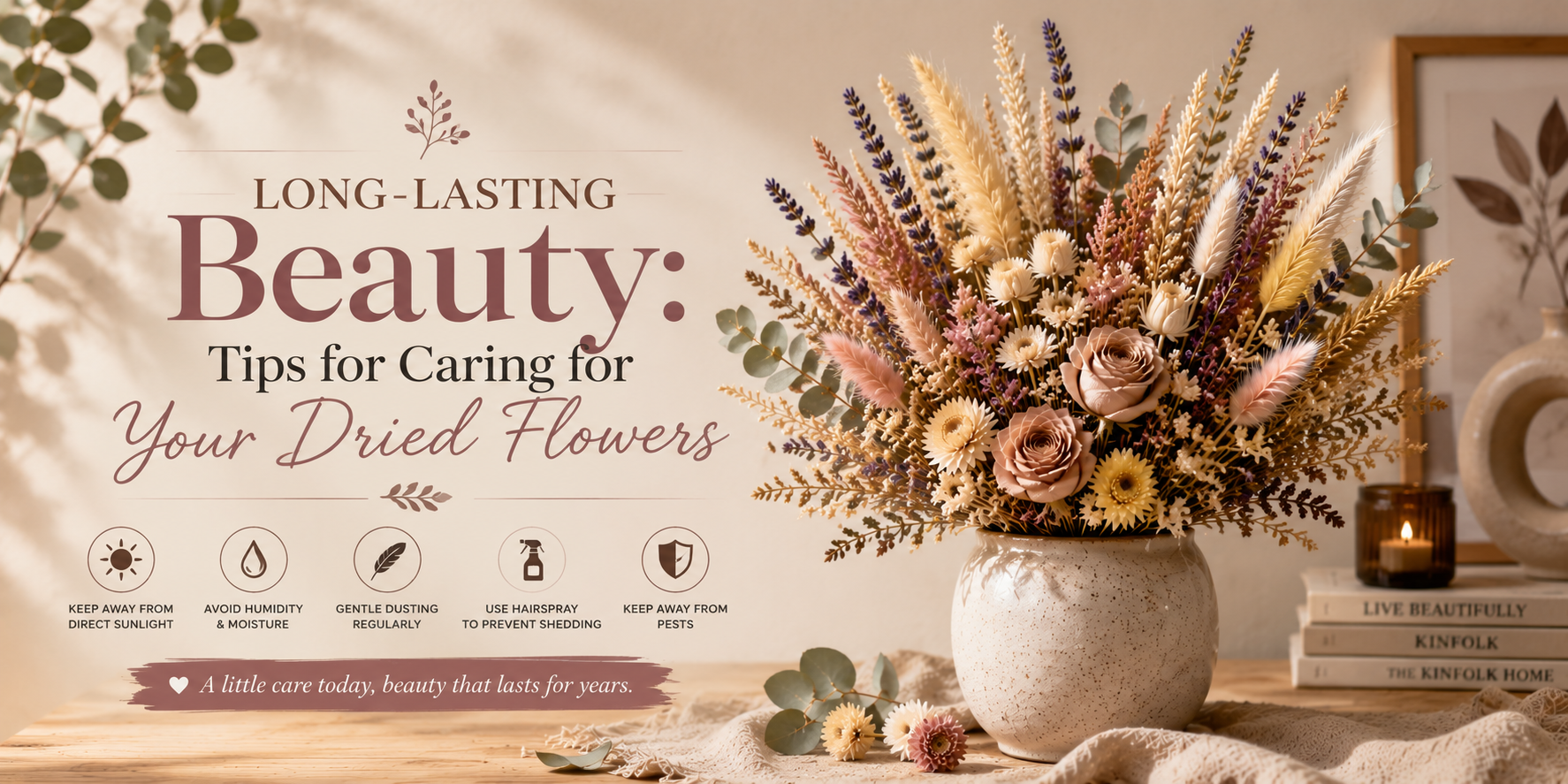
Long-Lasting Beauty: Tips for Caring for Your Dried Flowers
Introduction
One of the biggest draws of a dry flower bouquet is the promise that it doesn't demand much from you. No watering schedule, no wilting deadline, no frantic vase-water changes before guests arrive. But "low maintenance" doesn't mean "no maintenance" and the difference between a dried arrangement that looks beautiful for three years and one that fades within a few months usually comes down to a handful of simple habits.
If you've recently brought home dried flowers online, or you're planning to, this guide will walk you through exactly how to care for them properly, from where to place them, to how to keep them dust-free, to preventing shedding and pests. We'll also cover something that's just as important as care: sourcing. Not all dried flowers are created equal, and where you buy from can make a bigger difference to longevity than almost anything you do after the fact. By the end of this guide, you'll know how to get the absolute most out of your arrangement, whether it's sitting on a console table, a bookshelf, or a bedside nightstand.
Setting the Stage: The Golden Rules of Placement
Before we get into active maintenance, it's worth pausing on something people often overlook entirely: where you actually place your dried arrangement matters just as much as how you clean it.
Sunlight is the number one enemy of colour retention. Dried flowers, especially warmer-toned varieties like roses, strawflowers, and statice, are prone to fading when exposed to direct or prolonged sunlight. UV rays don't just dull colour, they also make petals more brittle and prone to crumbling over time. If you love displaying your arrangement near a window, consider a spot with indirect or filtered light rather than a sill that gets hours of direct sun each day.
Humidity is the second major factor, and it's one that's easy to underestimate in Indian homes, especially during monsoon season or in coastal cities. Dried flowers are, by nature, moisture-free, that's what gives them their shelf life. Placing them in a bathroom with poor ventilation, near an open kitchen stove, or in a room with a humidifier can cause them to reabsorb moisture from the air. This often shows up as drooping petals, a softened structure, or in worse cases, mould developing at the base of the stems.
A good general rule: choose a well-lit but shaded spot, ideally in a room with decent air circulation and away from direct exposure to steam or heavy moisture. A living room console table, a dry bedroom corner, or a hallway shelf tend to be ideal placements.
Step-by-Step Maintenance Guide
Once your arrangement is placed well, the ongoing care required is refreshingly minimal, but a little consistency goes a long way.
Gentle Dusting Techniques
Dust is, without question, the most common reason dried arrangements start to look tired. Because dried flowers have a slightly textured, matte surface, they naturally attract airborne dust faster than smooth, glossy decor items.
The good news is that cleaning them is simple, as long as you avoid one common mistake: never use water or a damp cloth. Moisture is the enemy here, and even a light wipe-down can cause petals to droop, discolour, or develop spots. Instead:
-
Use a soft makeup brush or a clean, dry paintbrush to gently sweep dust off petals and stems, working from the top of the arrangement downward.
-
A hairdryer on its coolest, lowest setting, held about 30-40 centimetres away, can blow loose dust out from between tightly packed blooms without disturbing their shape.
-
For larger arrangements or more delicate blooms, a can of compressed air (the kind used for cleaning electronics) offers precise, gentle control.
Aim to dust your arrangement every one to two weeks if it's in a high-traffic, open room, or once a month if it's tucked away somewhere less exposed to airborne dust, such as inside a glass display case or cabinet.
Combating Shedding (The Hairspray Trick)
Some shedding is natural and expected, especially with delicate filler flowers like baby's breath or statice. However, excessive shedding is often a sign that the arrangement needs a bit of extra reinforcement, and this is where a well-known florist trick comes in.
A light, even mist of unscented hairspray, held about 30 centimetres away from the arrangement, helps set the petals and stems in place, significantly reducing shedding over time. The key word here is "light" you're aiming for a fine, even coating, not a heavy spray that leaves visible residue or clumping. This technique works especially well right after you first receive a new arrangement, before dust or handling has had a chance to loosen any petals, and can be reapplied every few months as a light refresh.
If you notice a bloom shedding more heavily than the rest, it's usually fine to gently remove it rather than leave loose petals scattered around your display, this keeps the overall arrangement looking tidy without needing to replace anything.
Bug Prevention
Because dried flowers are made from real plant material, they can, in rare cases, attract small pests, particularly if stored or displayed in a humid environment. This is uncommon with properly dried, high-quality flowers, but it's still worth a few precautionary habits:
-
Keep arrangements away from open food storage areas, particularly in kitchens.
-
Store any extra or spare dried stems in a sealed container with a silica gel packet, which helps absorb residual moisture and deters pests.
-
Do an occasional visual check, especially in warmer, more humid months, for any tiny insects or webbing near the base of the stems.
-
If you do notice pest activity, isolate the arrangement immediately and consider placing it in direct sunlight for a short period (a rare exception to the sunlight rule), as this can help deter pests before you decide whether to keep or discard the affected piece.
Following these three habits dusting, light hairspray reinforcement, and basic pest awareness, is genuinely all it takes to keep most arrangements looking fresh for years.
Buying Quality: Why the Source Matters
Here's something worth being honest about: no amount of careful maintenance can fully compensate for a poorly made arrangement. If the flowers weren't dried thoroughly to begin with, or if they were packaged carelessly during transit, you'll likely notice problems within weeks, no matter how well you care for them afterward, excessive shedding, patchy fading, or even early signs of mould.
This is exactly why sourcing deserves just as much attention as care technique. When shopping for natural dried flowers online India-wide, a few signs separate a reliable seller from a risky one:
-
Transparency about the drying process. A trustworthy florist should clearly state whether an arrangement is air-dried, silica-dried, or preserved, since each has different care needs and expected lifespans.
-
Careful, protective packaging. Dried flowers are delicate in transit, and poor packaging is one of the most common causes of damage before an arrangement even reaches your door.
-
Clear care guidance at the point of sale. A seller who genuinely stands behind their product should be willing to tell you how to care for it, not just sell it and move on.
At Floral Boutique, we treat sourcing and packaging as seriously as we treat the design of the arrangement itself, because a beautifully styled bouquet that arrives damaged or poorly dried isn't a good experience for anyone. Every order is packed with care to protect delicate blooms in transit, so that the maintenance tips above are working with a solid foundation, not compensating for a shortcut taken earlier in the process.
Conclusion
Caring for dried flowers isn't complicated, but it does reward a bit of consistency. Get the placement right, dust gently every couple of weeks, use the hairspray trick if shedding becomes an issue, and keep an eye out for pests in humid conditions, and your arrangement will comfortably reward you with years of beauty rather than months.
Of course, all of this care starts with a good foundation. If you're browsing dried flowers online, take the time to choose a seller who's transparent about their process and careful with their packaging, it makes every one of these care tips work harder for you. Ready to bring home an arrangement built to last? Explore Floral Boutique's collection of thoughtfully sourced dried flower bouquets, and give your space a piece of decor that's as low-effort as it is long-lasting.
Frequently Asked Questions
1. Where should I place my dry flower bouquet for the longest life?
Somewhere well-lit but out of direct sun, and away from humidity, a console table or a drier corner of the bedroom works well. Sunlight fades the colour over time, and humidity is what leads to drooping or mould.
2. How often should I dust my dried flower arrangement?
Roughly every one to two weeks if it's in an open, high-traffic room. Once a month is usually enough if it's kept somewhere more sheltered, like inside a display case.
3. Can I clean dried flowers with water?
No, water or a damp cloth will make petals droop, discolour, or grow mould. Stick to a soft brush, a hairdryer on a cool setting, or compressed air instead.
4. What is the hairspray trick for dried flowers?
It's just a light mist of unscented hairspray, held about 30 centimetres from the arrangement, to help set the petals and cut down on shedding. Works especially well on more delicate filler flowers.
5. Do dried flowers attract bugs?
Not usually, if they're properly dried and good quality, but humid storage can sometimes bring pests around. Keeping things dry, and using a silica gel packet for any stored stems, keeps that risk low.
6. Why does the source matter when buying dried flowers online?
Because flowers that weren't dried or packaged well will shed, fade, or mould no matter how well you look after them afterward. Good sourcing matters just as much as good maintenance.
7. How long can natural dried flowers from India last with proper care?
With the right placement and a bit of regular upkeep, natural dried flowers from India typically last one to three years, depending on the variety and how they're stored.
8. Is it normal for dried flowers to shed a little over time?
Yes, a bit of shedding is completely normal, especially with delicate fillers like baby's breath or statice. If it's shedding a lot more than that, a light hairspray refresh usually sorts it out.